
Self-Sabotage with Compassion
Why We Do It and How to Return Gently

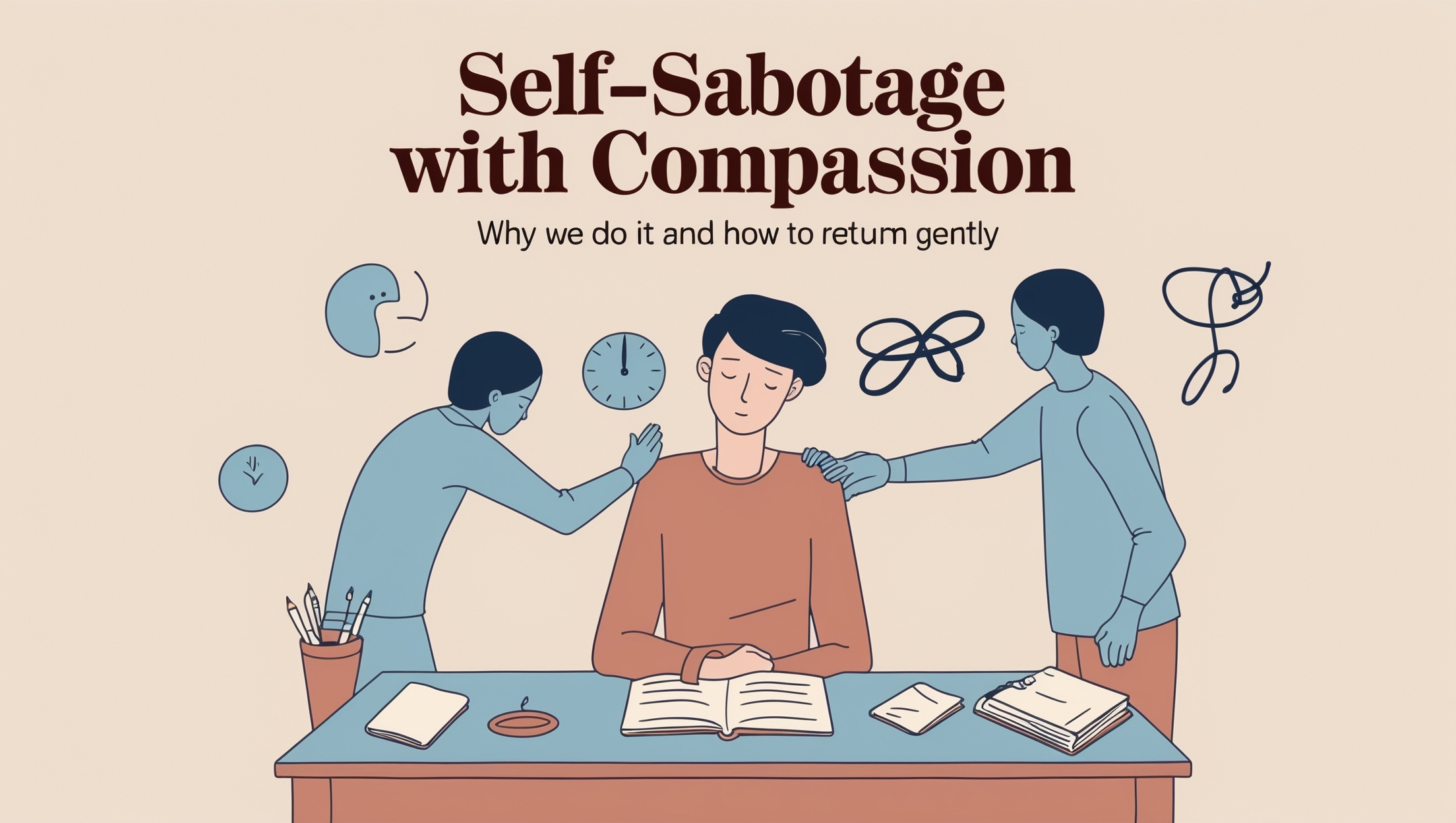
We’ve all been there.
You finally start something important.
You get traction. You feel momentum.
And then, without warning, you stall.
You avoid the project.
You scroll instead of starting.
You reach for the exact habit you swore you were done with.
That sinking thought shows up:
Why do I keep doing this to myself?
This is self-sabotage.
And while it feels irrational, it actually has a logic.
One that makes more sense when you meet it with compassion instead of criticism.
Why We Self-Sabotage
Self-sabotage isn’t laziness.
It’s protection.
Deep down, your brain associates progress with risk.
If you finish the project, people might judge it.
If you get healthier, people might expect more from you.
If you change too much, you might lose your sense of who you’ve always been.
So instead of letting you leap forward, your mind quietly pulls the brakes.
Not because it hates you.
Because it fears the unknown.
This doesn’t excuse it.
But it explains it.
And when you understand self-sabotage as misplaced protection, you stop seeing yourself as broken.
You see yourself as human.
Why Compassion Matters More Than Criticism
Most people try to beat self-sabotage with force.
Push harder. Shame yourself into action.
Set stricter rules.
But harshness makes the pattern worse.
Criticism deepens fear.
Force signals danger to your nervous system.
Compassion does the opposite.
It lowers the threat.
It makes room for choice.
It creates the safety you need to move again.
Try This: The Gentle Return Method
Next time you notice yourself sabotaging, pause and use these three steps:
1. Name the Pattern Without Judgment
Say to yourself: “I’m avoiding this right now. That’s okay. I know what’s happening.”
Awareness dissolves shame.
2. Ask: What am I protecting myself from?
Is it fear of failure? Fear of being seen? Fear of the effort required?
Get curious, not cruel.
3. Take One Micro-Step Back Toward Alignment
Don’t plan the whole project.
Don’t commit to a big leap.
Just take one small step that restores movement.
Open the file. Write one line. Put your shoes by the door.
This reintroduces safety and progress at the same time.
Why This Works
You’re not fighting yourself.
You’re listening.
You’re telling your nervous system: We’re safe to move forward.
You’re reframing sabotage as a signal — not a verdict.
And little by little, you retrain your brain.
Not to avoid, but to allow.
Not to fear progress, but to trust it.
A Closing Reminder
Self-sabotage isn’t evidence that you’re weak.
It’s evidence that you’re human.
It’s your old protective wiring trying to keep you safe in a new chapter.
You don’t overcome it by attacking yourself.
You move through it by staying curious.
By offering compassion where you used to offer critique.
By returning, gently, to the path you’ve chosen.
Each time you do
You prove to yourself that growth doesn’t have to mean danger.
It can mean safety, alignment, and strength.
That’s how you turn sabotage into self-trust.
Wao it's amazingly effective on me
Please subscribe me so I can get hold on my present and written much more for better fiction for readers it's a katharcise